

Today, every business is transforming from manual to digital. But before launching the first digital product, how would you ensure that your idea would be successful in the market? Here, MVP jumps into the picture. MVP, i.e., Minimum Viable product is the only solution to validate your application idea and market feasibility. Consequently, MVP app development has also become the latest trend in the market.
So, in this blog, we will have a detailed discussion on MVP. Adopting MVP is not a simple game. You need to know the competitive benefits, market range, right methods, and cost of developing a Minimum Viable product. We aim to offer you an unbiased standpoint on MVPs and when you must choose one to cultivate productivity for your business.
Key Takeaways:
- Market Size of MVP App Development in 2026
- MVP App Development Vs Full-Scale Applications: Understand the Fundamental Differences
- MVP Vs Prototype Vs POC: They aren’t the same!
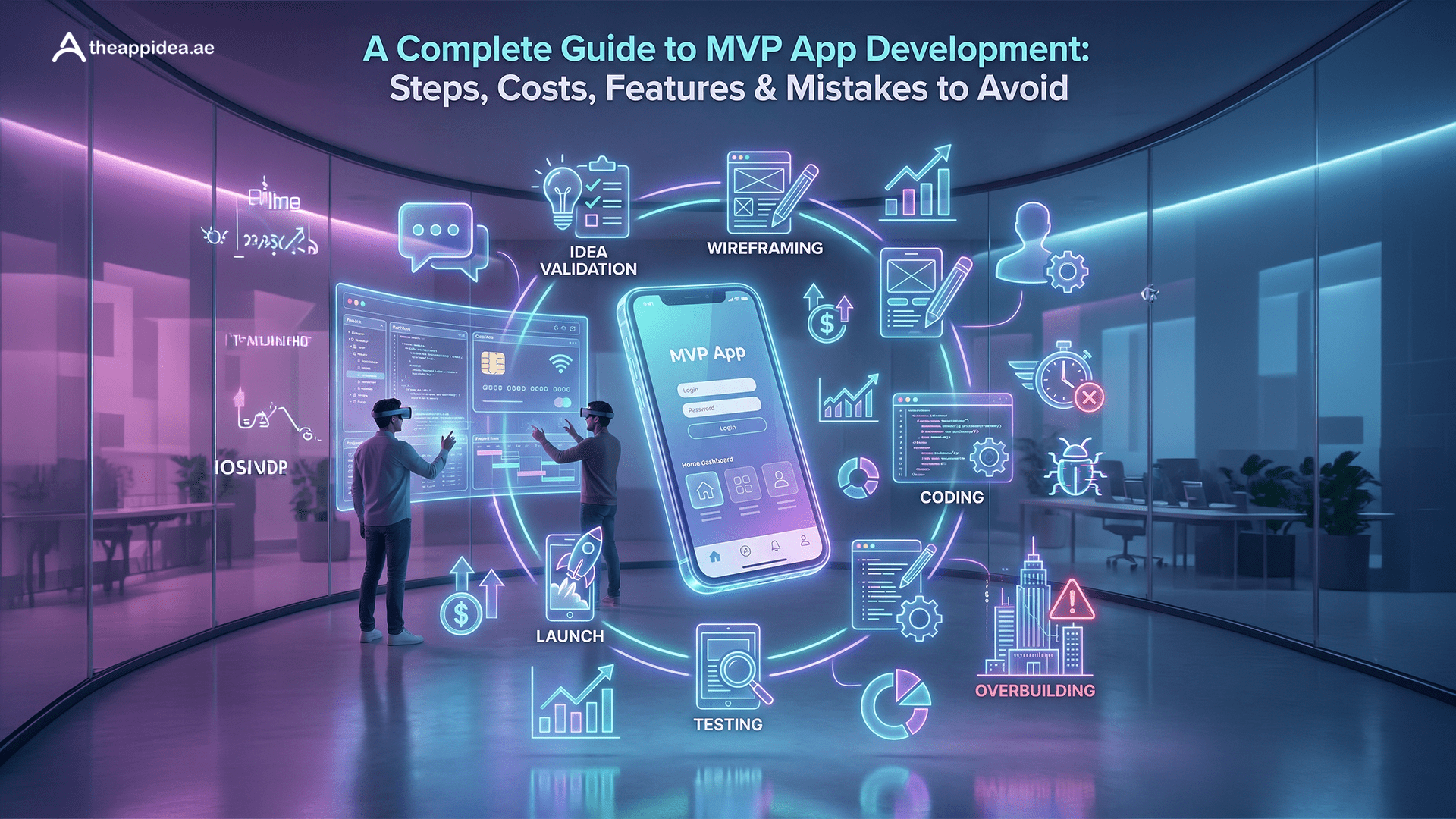
- MVP App Development: 9 Comprehensive Steps to Win the Game
- MVP App Development Mistakes to Avoid
- Check Your Budget Feasibility for MVP App Development Services in 2026
- Bottomline: Ask the Right Questions to Hire MVP App Developers
- FAQ (Frequently Asked Questions)
Market Size of MVP App Development in 2026

A study from 360iResearch says that the global MVP development services market is valued at approximately $2.74 billion in 2026 and is projected to reach $6.52 billion by 2032, growing at a CAGR of 15.24%.
Statistics from Future Market Report say that the MVP building tools market is expected to grow from $750 million (2024) to over $1.6 billion by 2032, showing strong demand for rapid product validation solutions.
Another survey from Intel Market Research says that over 70% of startups now adopt MVP development approaches before building full-scale products to reduce risk and validate market fit.
A Planetarylabour survey claims that startups using MVP strategies are 3x more likely to secure early-stage funding, making MVPs a key driver in the startup ecosystem.
MVP App Development Vs Full-Scale Applications: Understand the Fundamental Differences
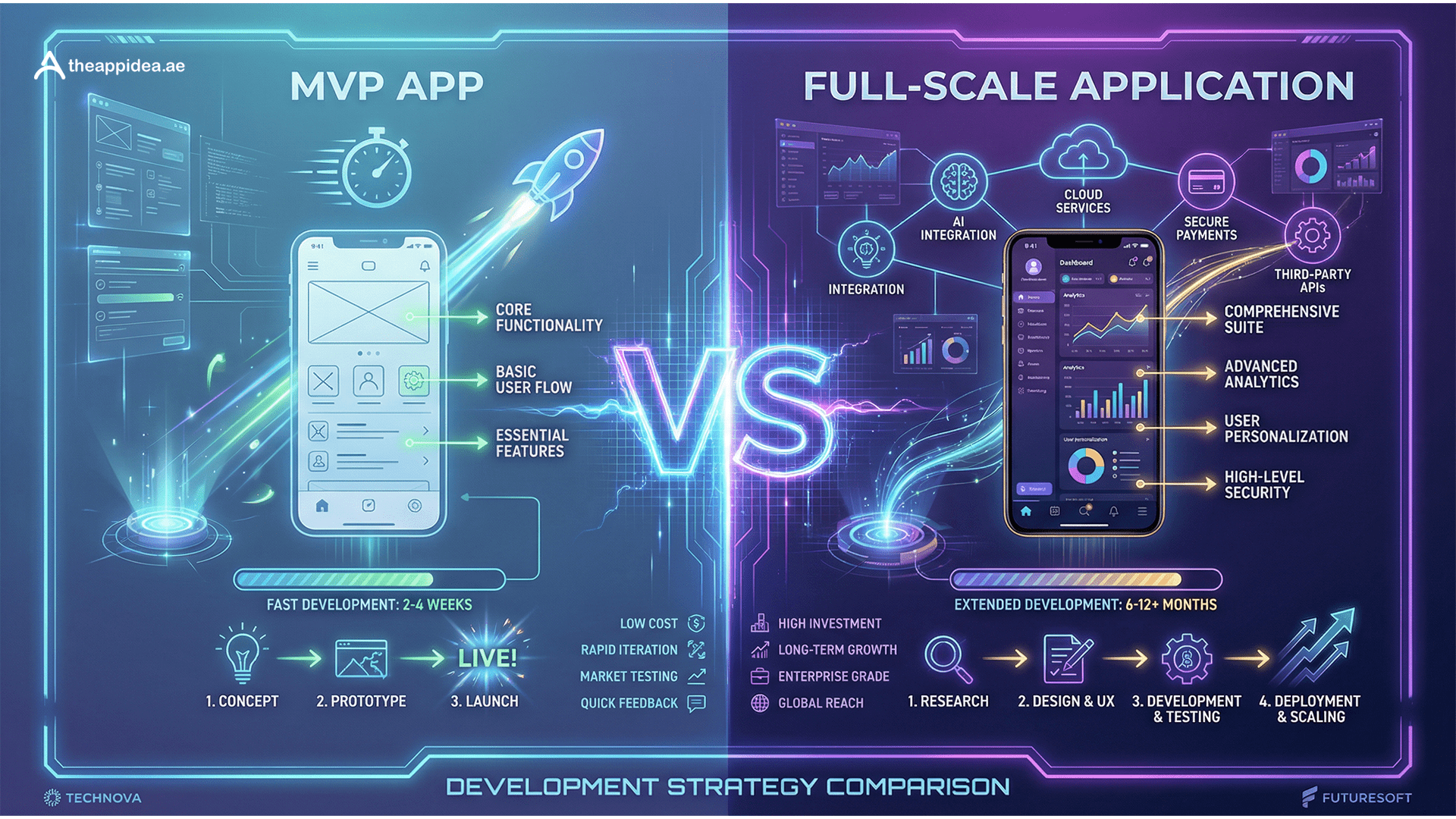
You need to figure out the end-to-end difference between MVP and full-scale applications. To make the differences clear, we have bifurcated the parameters into multiple aspects, including Purpose, Features, Time-to-Market, Budget Complexity, Risk Management, User Base, UI/UX Design, Scalability, and Feedback Cycle.
What is an MVP App?
An MVP or Minimum Viable Product is the base format of an application that comes with fundamental features offering solutions to the core problems. The main objective is to get an idea of the market sustainability with minimum investment and technical resources.
What is a Full-Scale Application?
A full-scale application is a full-fledged solution developed by software engineers that comes with advanced features, pole-to-pole UI/UX, scalable backend architecture, and interactive AI integration, ready for catering to mass users across the competitive marketplaces.
| Aspect | MVP App | Full-Scale Application |
|---|---|---|
| Purpose | Idea validation | Business growth & scalability |
| Features | Limited, core features only | Complete feature set |
| Development Time | 1–4 months | 6–12+ months |
| Cost | Low ($10,000–$60,000) | High ($60,000–$250,000+) |
| Risk Level | Low (test before investing big) | High (large upfront investment) |
| User Base | Early adopters | Mass audience |
| UI/UX Design | Basic but functional | Highly polished and optimized |
| Scalability | Limited | Fully scalable architecture |
| Feedback Cycle | Continuous iteration | Post-launch optimization |
MVP Vs Prototype Vs POC: They aren’t the same!

Let’s figure out the list of differences between a Minimum Viable Product, Prototypes, and Proof of Concept.
MVP
As we discussed earlier, MVP is the solution, built just for product testing. It encapsulates basic and essential features, focused on real users, to validate the business idea and check market compatibility.
Use MVP When:
- You are ready to launch in the market
- You want real user feedback
- You aim to validate and scale your business idea
Prototype
A prototype is an early-stage, preliminary, and interactive model that depicts the end-to-end visuals and functions of the product after it is completely developed. A prototype is generally built to understand the design workflow and user experience.
Use Prototype When:
- You need to visualize the product
- You want stakeholder or investor approval
- You are refining UI/UX design
POC
POC stands for proof of concept. It is technically the first stage of validation of your product, where you validate that the idea would work in the market. It particularly defines the functional and technical feasibility of the product.
Use POC When:
- You are testing a new or complex technology
- You are unsure if the idea is technically possible
- You want to reduce technical risks early
| Aspect | POC (Proof of Concept) | Prototype | MVP (Minimum Viable Product) |
|---|---|---|---|
| Purpose | Test feasibility | Visualize design & flow | Validate business idea |
| Stage | Idea stage | Pre-development | Post-development (initial launch) |
| Functionality | Minimal or none | Limited interaction | Fully functional core features |
| User Involvement | Internal stakeholders | Limited user testing | Real users |
| Development Time | A few days to weeks | 1–3 weeks | 1–4 months |
| Cost | Low | Moderate | Higher than POC & Prototype |
| Outcome | Feasibility confirmation | Design approval | Market validation |
| Risk Level | Very low | Low | Moderate |
MVP App Development: 9 Comprehensive Steps to Win the Game
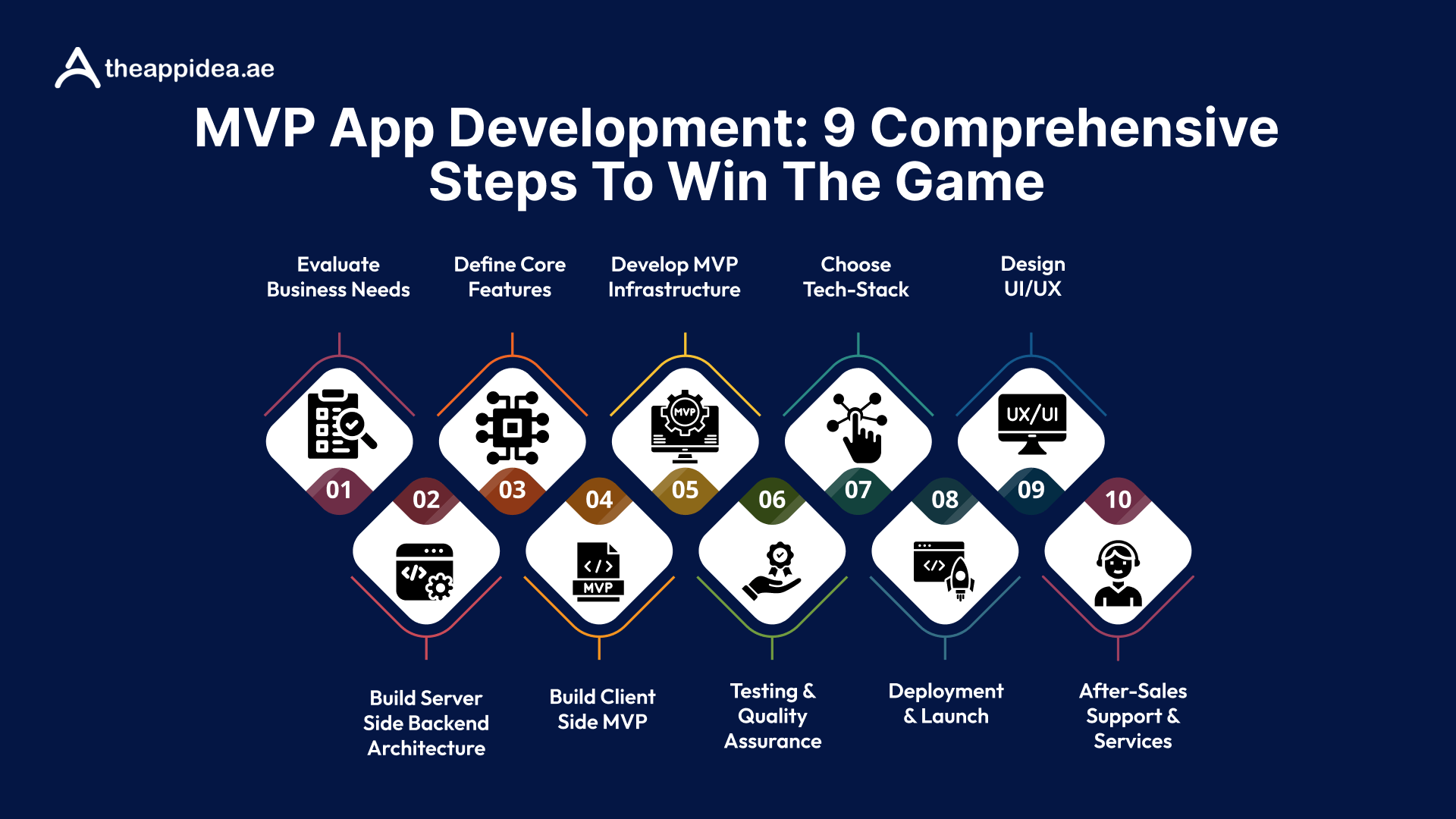
Now, here comes the most important section of the blog. Here, you will learn about the 9 comprehensive steps while building an MVP for your business.
Let’s proceed.
Evaluate Business Needs
Defining the business need is the primary stage where you build a clear foundation for MVP development. In this stage, you identify the problem, define the solution, recognize the target audience, validate the business idea, and make a plan-of-action on how your MVP is going to align with the business needs.
Define Core Features
This is stage 2. Here, you identify the core feature that can homogeneously align with the requirements of the business. The developers must focus on must-have features and ignore the unnecessary functions. The main goal is to align with the business requirements and keep it simple.
Develop MVP Infrastructure
A good MVP infrastructure ensures the scalability, security, and functions of the application. Here, you choose scalable hosting, align data infrastructure, ensure data security, optimize performance, and plan future scalability of the application for your business.
Choose Tech-Stack
Choose the technologies that will cater to the speed, performance, and scalability of the application. Focus on choosing the tools that would ensure faster development, a future-ready solution, future expansion, and a scalable MVP architecture.
Design UI/UX
A well-designed UI/UX improves usability and engagement. Focus on intuitive navigation, user-friendly layouts, and seamless interactions to ensure users can easily understand and interact with your MVP.
Build Server Side Backend Architecture
A strong and scalable backend infrastructure handles high-volume business delivery, massive data processing, and seamless communication between the server and frontend components. The consolidated responsibilities of the developers is to develop APIs, ensure data security, manage databases, enable scalability, and facilitate performance optimization.
Build Client Side MVP
The client-side MVP is the frontend development that involves creating an interactive and intuitive interface for a seamless user experience. The job is to ensure fast performance, integrate API, optimize navigation, enable smooth function, maintain consistency, and connect backend services with APIs.
Testing & Quality Assurance
Testing and Quality Assurance ensure your MVP performs reliably, remains secure, and delivers a seamless user experience. It involves identifying bugs, validating features, checking performance, and ensuring compatibility across devices, helping reduce risks, improve stability, and build user trust before launch.
Deployment & Launch
This stage of deployment and launch involves plating the services to primary end users. The developers would configure the production environment, deploy applications, initiate performance monitoring, enable a smooth launch, and prepare a rollback plan.
After-Sales Support & Services
Post-delivery support and maintenance service is the insurance for your application’s sustainability. It offers regular updates, performs bug fixing, ensures functional optimization, monitors performance, and plans future enhancements. After-sales support and maintenance strive to offer long-term business success.
MVP App Development Mistakes to Avoid
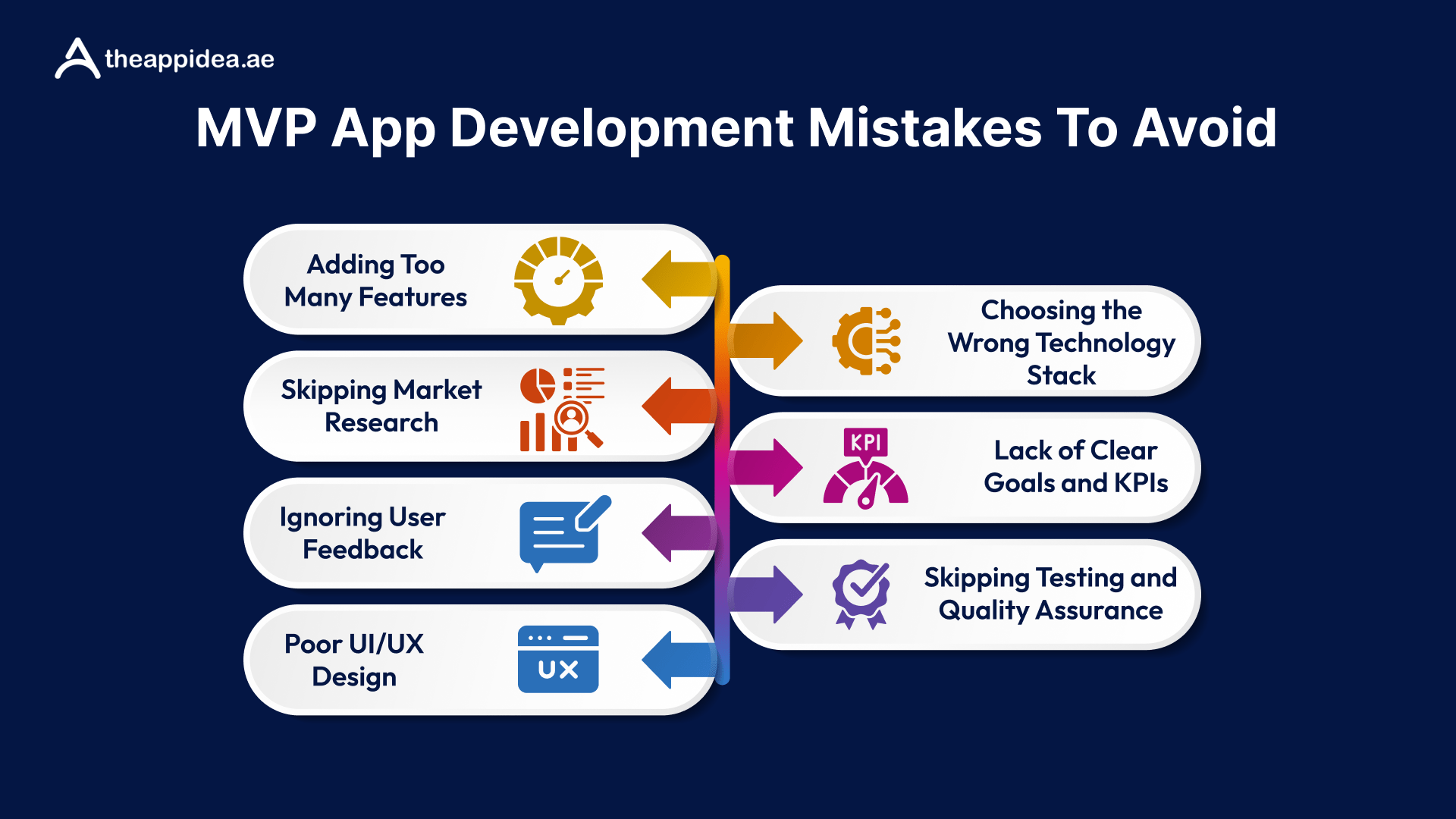
Have you ever wondered why an MVP app fails? It’s time to explore some of the mistakes that you must not commit while developing an MVP for your business. Also, know how to avoid MVP development mistakes.
Adding Too Many Features
Excessive integration of unnecessary features would not only change the true meaning of MVP but also increase the overall MVP app development cost. Rather, we should focus on basic features that give solutions to the primary users.
Skipping Market Research
Ignoring detailed market research would never give you an idea of what the users are actually looking for. A pole-to-pole competitive analysis, market research, trend observation, and profit scope would help you build the best version of MVP.
Ignoring User Feedback
User feedback is the most important aspect for improvement and growth. When you make a survey as a medium to collect user opinion, there would be a productive emergence of on-the-fly iteration.
Poor UI/UX Design
No matter if you are targeting the fundamental version of an application, a poor UI/UX may ruin the entire customer experience. Thus, relying on unattractive and unengaging UI/UX is the worst part of an MVP app development.
Choosing the Wrong Technology Stack
Selecting the wrong technology stack affects performance, scalability, and costs. Choose technologies that support quick development, flexibility, and future growth without unnecessary complexity.
Lack of Clear Goals and KPIs
Without clear business objectives and concrete KPIs to measure the application’s success, you will never succeed in building a high-performing MVP. The metrics may include user engagement, retention rate, and conversion ratio.
Skipping Testing and Quality Assurance
A proper testing and QA session is another mistake that you can commit while building an MVP. Proper quality assurance ensures reliability, smooth functionality, and a better user experience before launching your MVP.
Check Your Budget Feasibility for MVP App Development Services in 2026
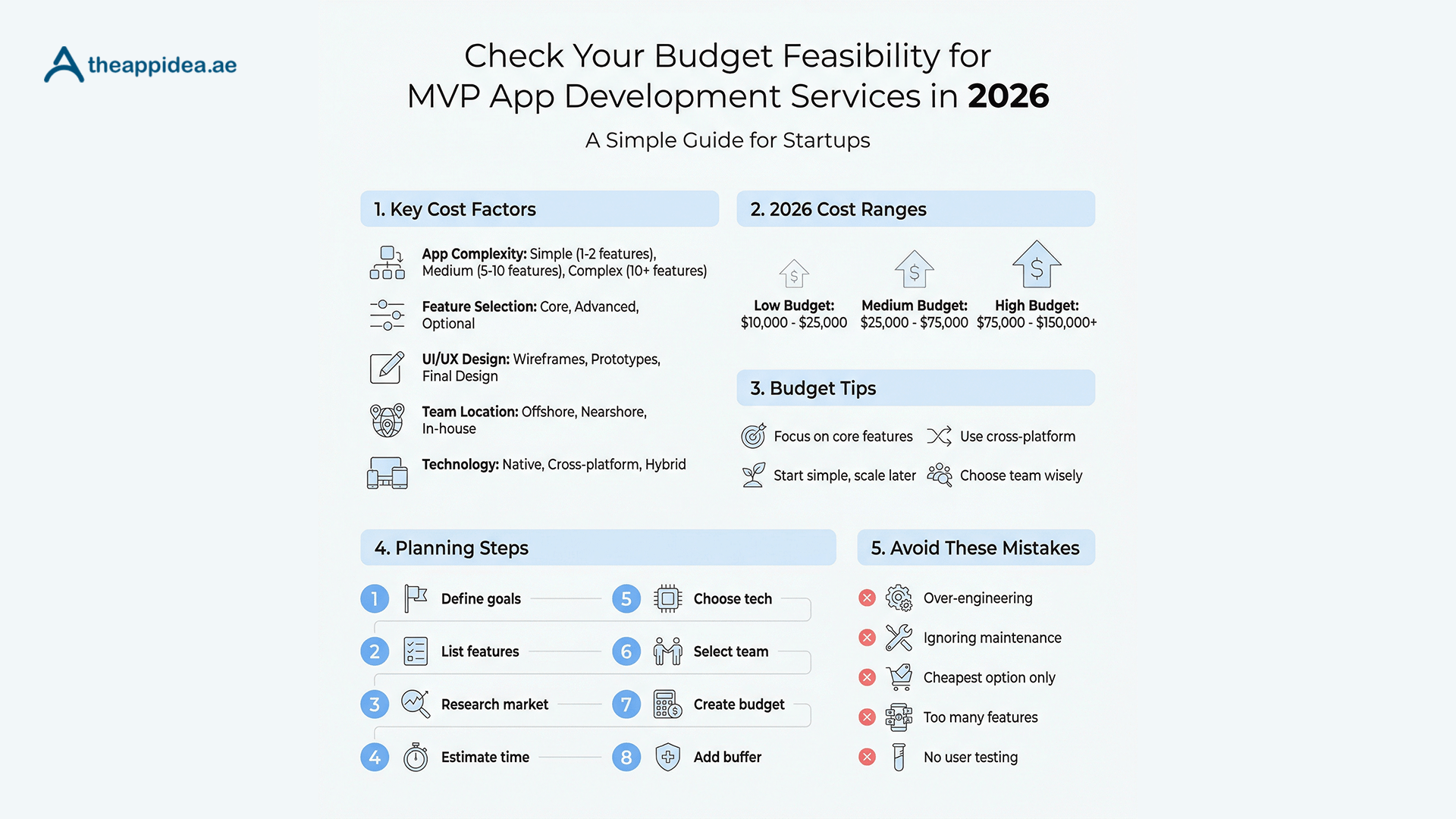
Take note of the MVP mobile app development cost in 2026.
| MVP Type | Features Included | Development Approach | Timeline | Estimated Cost |
|---|---|---|---|---|
| No-Code MVP | Landing page, basic validation, forms | No-code tools (Webflow, Bubble) | 1–3 weeks | $2,000 – $10,000 |
| Basic MVP | Core feature, simple UI, limited users | Low-code / simple development | 2–6 weeks | $10,000 – $25,000 |
| Standard MVP | User accounts, dashboard, APIs, integrations | Custom development | 1–3 months | $25,000 – $80,000 |
| Advanced MVP | Real-time features, AI, multi-platform | Full custom development | 3–6 months | $80,000 – $150,000+ |
| Enterprise MVP | High security, scalability, and compliance systems | Enterprise-grade architecture | 4–8 months | $150,000 – $300,000+ |
Bottomline: Ask the Right Questions to Hire MVP App Developers
So, now we have a complete idea of Minimum Viable Product and methods to approach its development. You also have end-to-end information on development cost, timeline, and the difference it holds with POC, Prototypes, and Full-scale application.
However, you must ask the right questions of the IT service provider before hiring it for MVP app development. So, here’s a list of 10 questions for you:
Question: What is your scope of MVP app development?
Intent: Evaluate the core features offered by your MVP app developer.
Question: Which features would you prioritize in the MVP application?
Intent: Understand the feature prioritisation in the entire framework.
Question: Can you share the past testimonials of building an MVP?
Intent: Analyse the previous track record of MVP app development.
Question: What is your tentative time-to-market for MVP app development?
Intent: Identify how quickly your digital product will be delivered to you.
Question: How do you handle the on-the-fly iteration during the MVP app development?
Intent: Understand the quick adaptability and tech expertise of the service provider.
Question: What is your tech-stack selection for MVP app development?
Intent: Identify how good the MVP mobile app development company is for choosing the right technologies for the right development methodologies.
Question: How do you validate the idea before starting the project?
Intent: A good MVP developer not only assists in development but also in idea generation.
Question: How do you look up to the client feedback and improvement in the MVP development phase?
Intent: Ensures data-driven decisions, reduces risk, and improves product-market fit.
Question: How do you streamline the budget management in MVP app development?
Intent: Know how much the developers are focusing on lean development practices.
Question: Are you comfortable sharing the feedback of your previous MVP clients?
Intent: Evaluate the success rate of the developers across the MVP domain.
These questions would help you evaluate the holistic competency of the mobile app development company focused on MVP development.
Hope this blog was insightful to you and has offered you all the necessary information possible!
FAQ (Frequently Asked Questions)
An MVP (Minimum Viable Product) is a basic version of an app with core features to validate an idea with minimal cost and time.
MVP app development typically costs between $10,000 and $100,000, depending on complexity, features, and development team location.
It usually takes 1 to 4 months to build an MVP, depending on the app’s complexity and development approach.
An MVP should include only essential features that solve the core problem, along with basic UI/UX and functionality.
An MVP has limited features for validation, while a full-scale app includes complete functionality and is built for scalability and mass users.
Yes, an MVP can be gradually enhanced with new features and infrastructure to evolve into a full-scale, scalable application.
MVP helps startups validate ideas, reduce risks, save costs, and gather real user feedback before making large investments.
Common mistakes include adding too many features, ignoring user feedback, poor UI/UX design, and skipping proper testing.
Popular technologies include React Native, Flutter, Node.js, Firebase, and AWS for building scalable and efficient MVPs.
Choose the best MVP app development company with a strong portfolio, relevant experience, transparent pricing, and good communication with post-launch support.

With extensive experience in the IT industry, Aman Mishra is passionate about empowering businesses and individuals through innovative mobile app development solutions. He regularly shares his expertise by writing insightful blogs on emerging mobile app trends, cutting-edge technologies, digital transformation, and industry best practices.
Beyond delivering mobile app development services across the UAE, he also specializes in providing comprehensive maintenance and support solutions for businesses of all sizes. His goal is to simplify complex technical concepts, address readers’ questions effectively, and provide valuable, actionable insights that help organizations make informed technology decisions and achieve long-term success.