

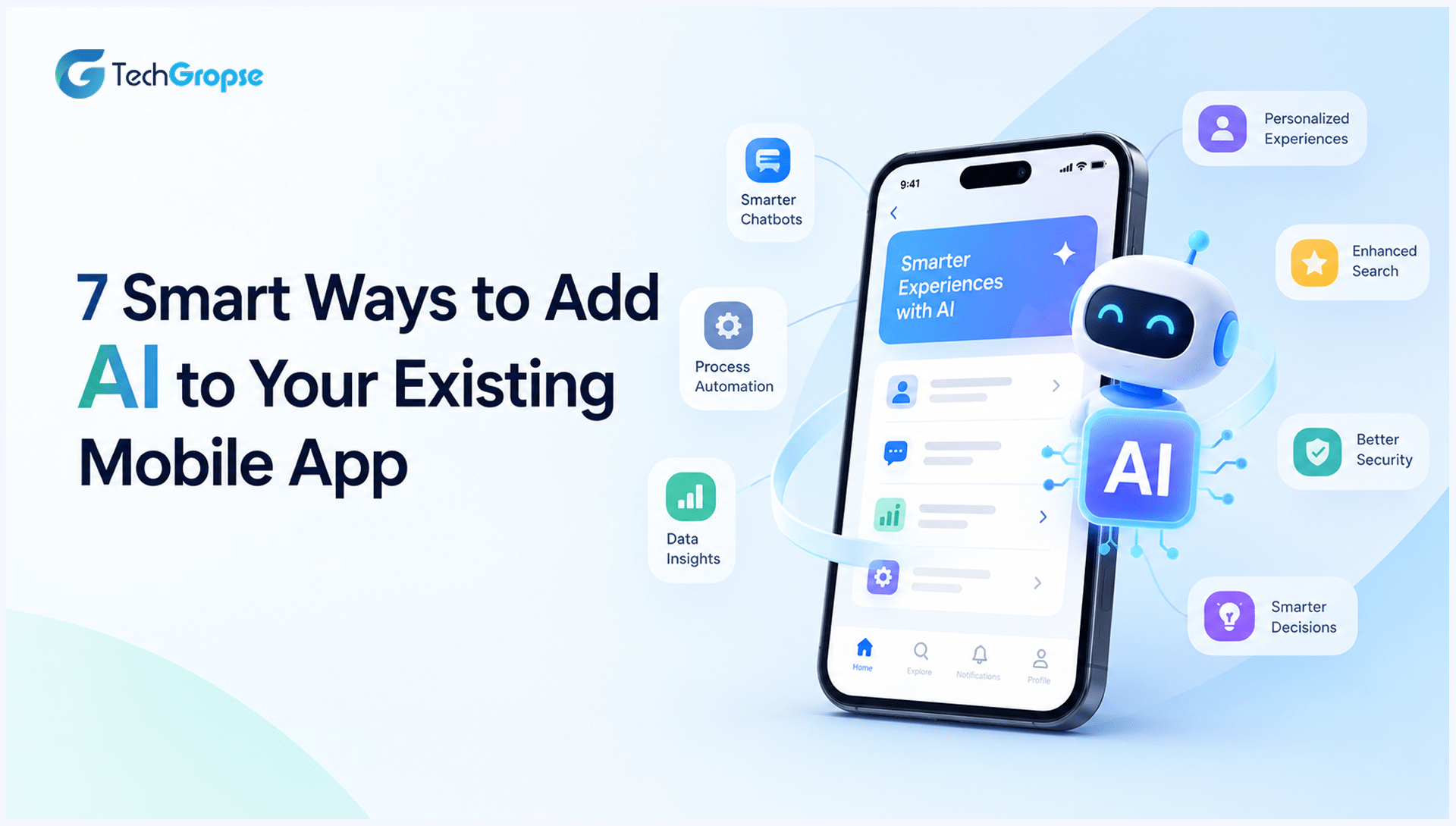
AI mobile app development doesn’t mean adding AI to any B2C or B2B app to build a new AI-powered app. Consider your app as a powerful tool with a robust foundation. It has users, workflow, business logic, required integrations, etc. But it has something more valuable: real customer behavior and usage data.
AI can be layered on to make your mobile app smarter. It adds functionalities so that your app can better understand users, predict their needs, and automate tasks to deliver a better CX.
Here, the million-dollar question is: how can your business add AI to an existing mobile app?
Businesses can integrate AI by using features like AI chatbots, personalized experiences, predictive analytics, intelligent search, voice interfaces, recommendation engines, and automated workflows. The good news is that you don’t have to start from the beginning. You can start with one high-value AI feature and expand over time.
In this guide, we will explore 7 smart ways to add AI to your existing mobile app. We will also look at how each approach can improve user experience, streamline operations, and create new opportunities for growth.
So, let’s dive in.
Can You Add AI to an Existing Mobile App?
Yes, in most cases, you can add AI to an existing mobile app. The best part is, you don’t need to begin from scratch. You can build on what already works and add intelligence where it matters most. Think of it as the engine that you need to upgrade instead of replacing your whole car. Your current mobile app can keep its core features, and AI handles specific tasks.
The UAE is also moving quickly toward AI-led digital experiences. According to PwC’s 2025 UAE CEO findings, 93% of UAE CEOs had adopted generative AI within the previous 12 months.
AI can be integrated through APIs, SDKs, backend services, or custom AI models. For example, APIs can connect your app with ready-made AI capabilities. SDKs can bring AI features closer to the mobile experience. AI integrations in mobile apps can be done through APIs, SDKs, or backend services. For simple connections, APIs and SDKs are useful. But for more advanced requirements, businesses can use backend AI services.
When Should Your Business Add AI Instead of Rebuilding It?
| Existing Situation | Recommended Approach |
|---|---|
| Stable app with good architecture | Add AI capabilities |
| Outdated backend | Modernize backend first |
| Poor UX but strong business logic | Improve UX + integrate AI |
| Legacy architecture | Partial modernization + AI |
| AI is core to the product | Consider bigger architectural changes |
7 Ways to Add AI to Your Existing Mobile App
Adding AI to a current mobile app should not be a shot in the dark. Below, we cover 7 practical ways to add AI to an existing mobile application. For each approach, we will explain what it does, how it works, and the business benefits it can deliver.
Add an AI Chatbot
Your business can get an AI-powered chatbot to transform your existing mobile app into a 24/7 digital support desk. It can answer common FAQs for app users. It enables your users to get personalized responses without the need for a human agent. It can also connect the chatbot with existing systems to provide real-time and context-aware assistance.
Key capabilities include:
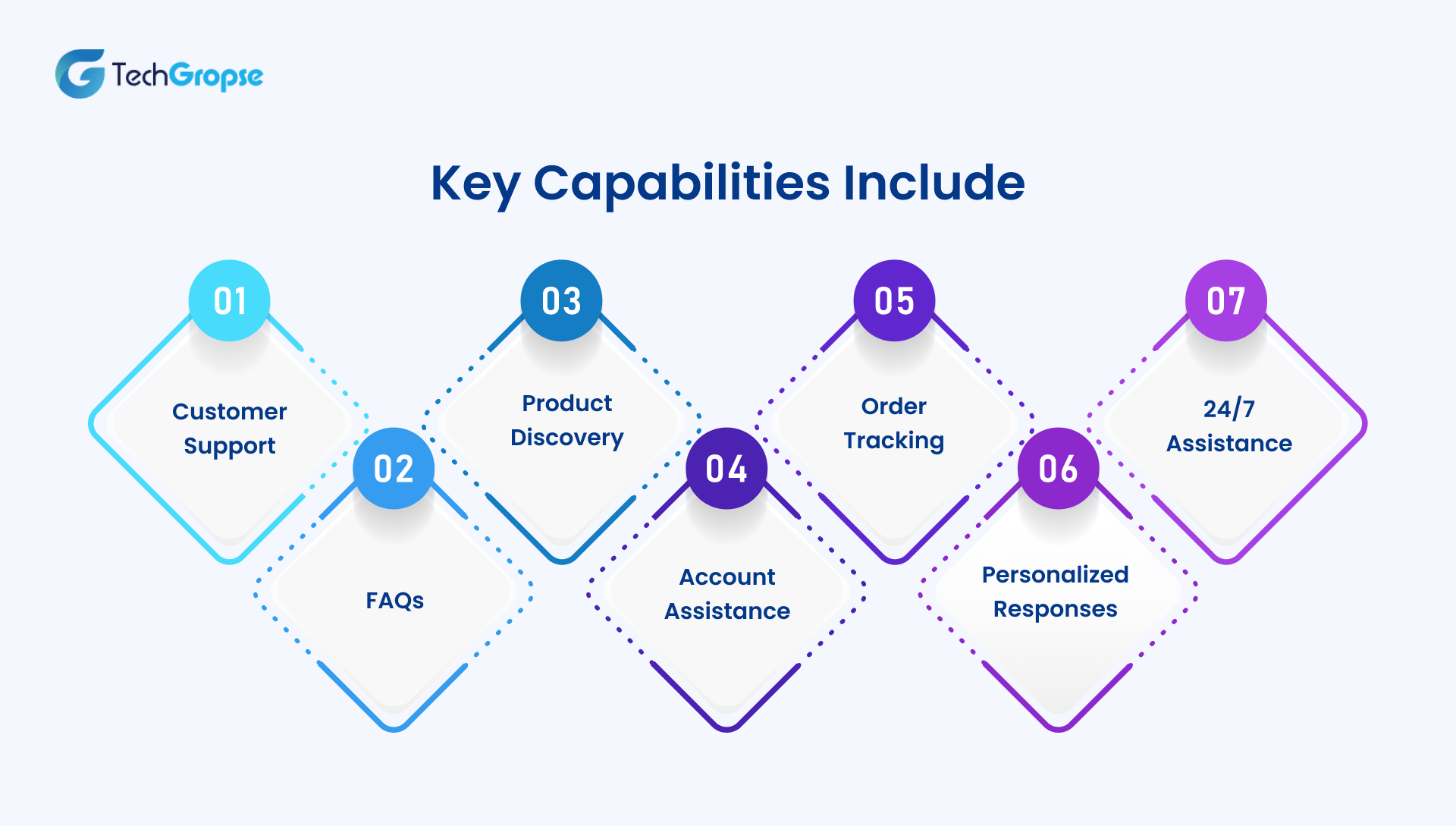
- Customer support
- FAQs
- Product discovery
- Account assistance
- Order tracking
- Personalized responses
- 24/7 assistance
How it Works
The chatbot connects the mobile application with the backend system and an AI model of your business.
Key technologies
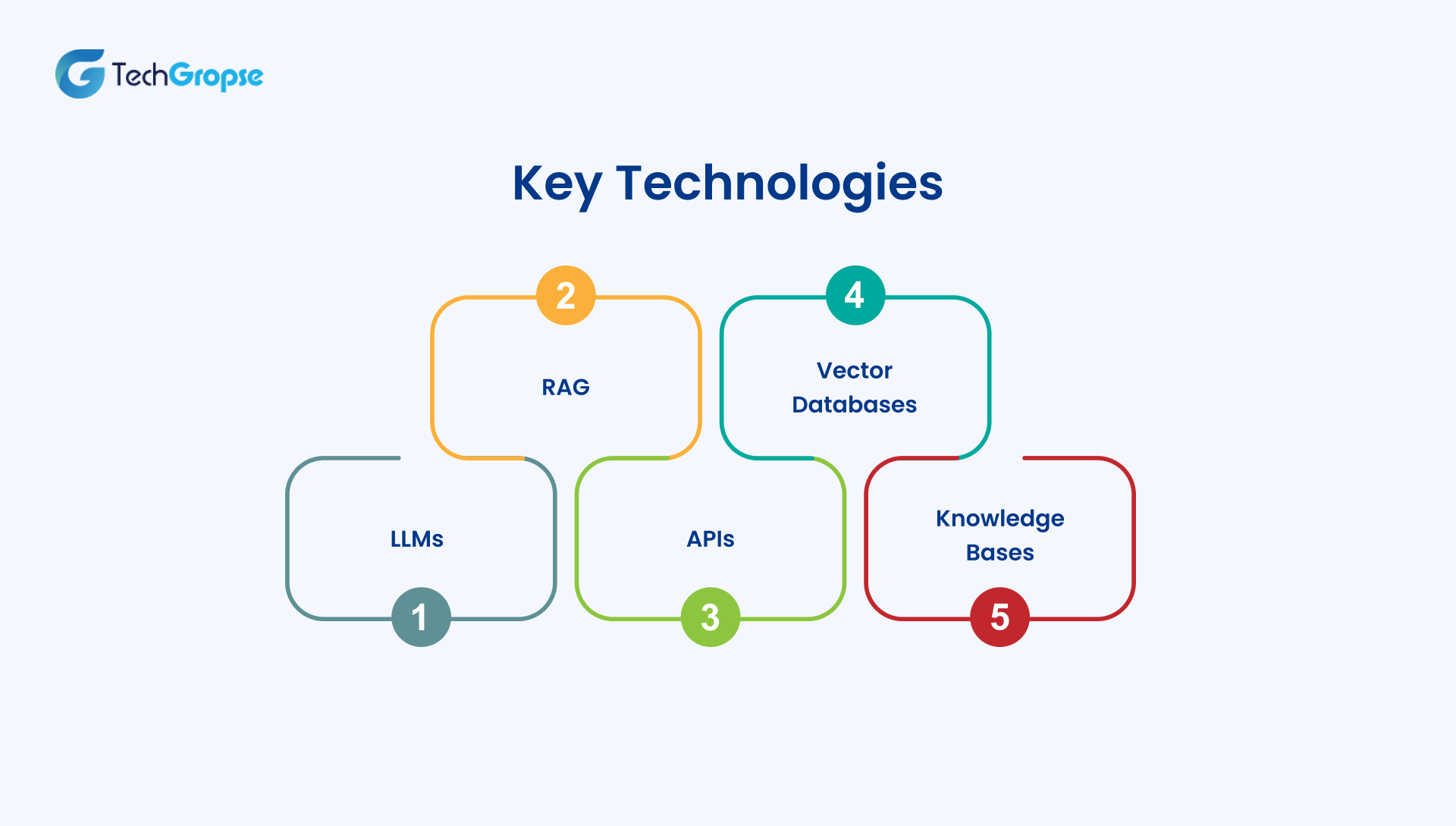
- LLMs
- RAG
- APIs
- Vector databases
- Knowledge bases
Ideal For
- Banking: Account queries, transaction assistance, and financial FAQs.
- Healthcare: Appointment support, service information, and patient assistance.
- eCommerce: Product discovery, order tracking, and shopping assistance.
- Travel: Booking support, itinerary help, and travel recommendations.
- Education: Course discovery, student support, and learning assistance.
- SaaS: Product guidance, troubleshooting, and customer support.
AI-Powered Personalization and Recommendations
AI can turn user data into highly relevant experiences. It can analyze user behavior, search history, purchase history, preferences, session activity, and content interactions. Based on these signals, AI can understand what each user is likely to need or prefer. The app can then personalize products, content, courses, offers, services, and notifications. This makes every interaction feel more relevant and less like a one-size-fits-all experience.
How it Works
- Analyze user behavior and interaction patterns
- Track search and purchase history
- Identify user preferences and interests
- Monitor session activity and engagement
- Understand content interactions
- Generate personalized recommendations
- Deliver targeted offers and notifications
Business Benefits
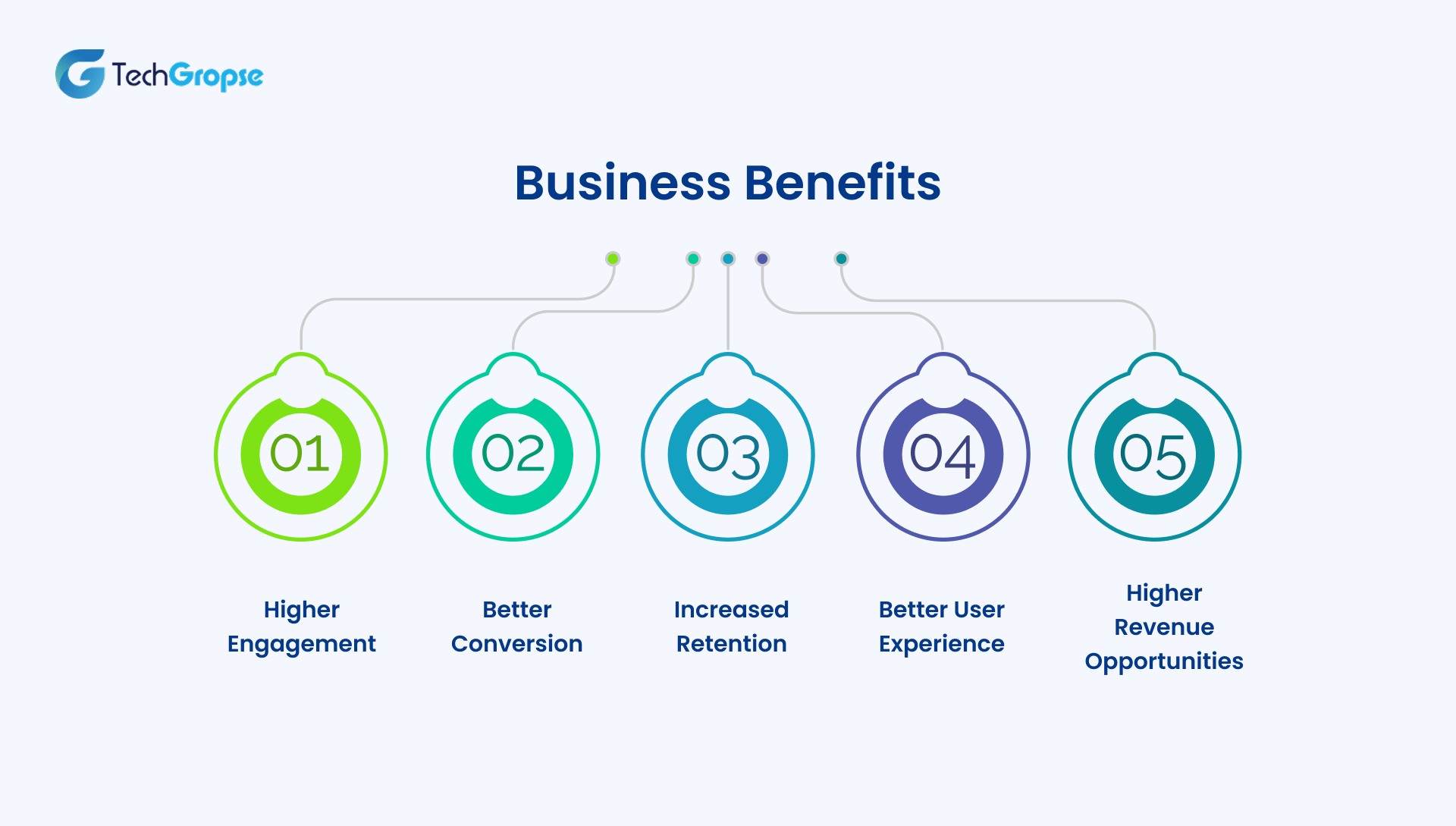
- Higher engagement
- Better conversion
- Increased retention
- Better user experience
- Higher revenue opportunities
Ideal For
- Banking: Account queries, transaction assistance, and financial FAQs.
- Healthcare: Appointment support, service information, and patient assistance.
- Media & Entertainment: Help users discover movies, shows, music, and content they may enjoy.
- Real Estate: Help users find properties based on location, budget, features, and preferences.
- Food Delivery: Help customers discover restaurants and dishes based on their tastes and requirements.
Upgrade Your App With Intelligent Search
Traditionally, search depends on keywords and exact matches. AI-powered search goes a step further by understanding intent, context, and meaning. An eCommerce business in the UAE can show its app users affordable running shoes without any need to enter the exact product keyword. It generates a smoother experience to help users find relevant results faster.
AI-powered search capabilities include:
- Semantic Search: Understands the meaning behind a query, not just matching keywords.
- Natural-Language Search: Lets users search using everyday language and complete sentences.
- Vector Search: Uses embeddings to find results based on semantic similarity.
- Conversational Search: Allows users to refine searches through natural, multi-turn conversations.
- Product Discovery: Helps users discover relevant products based on their needs and preferences.
- Content Discovery: Surfaces relevant articles, videos, products, or other content based on user intent.
Ideal For:
- E-commerce: Helps shoppers find relevant products using natural-language queries and preferences.
- Retail: Improves product discovery across large and frequently changing inventories.
- Travel: Helps users discover flights, hotels, and experiences based on their preferences.
- Healthcare: Helps patients find relevant doctors, services, and health information faster.
- Banking & Fintech: Helps customers quickly find transactions, services, and financial information.
- EdTech: Help learners discover relevant courses, lessons, and learning resources.
Bring Predictive Analytics Into Your App
Predictive analytics uses historical and real-time data to forecast what a user is likely to do next, before they take the action themselves. Instead of reacting to a churned subscriber or an abandoned cart after the fact, the app flags the risk while there is still time to act on it.
A fitness app can predict which users are likely to skip their next workout and nudge them with a reminder tailored to their past habits. A subscription-based SaaS product can flag accounts showing early signs of churn, weeks before cancellation, so the customer success team can step in. A logistics app can forecast delivery delays based on traffic patterns and driver history rather than waiting for a shipment to actually run late.
How it works
- Collect historical usage, transaction, and behavioral data
- Train models to identify patterns that precede a specific outcome
- Score users or events in real time against those patterns
- Trigger automated actions or alerts based on the score
- Refine the model as new outcome data comes in
Key Technologies
- Machine learning models (regression, classification, time-series forecasting)
- Data pipelines and event streaming (Kafka, AWS Kinesis)
- Feature stores for real-time scoring
- Cloud ML platforms (AWS SageMaker, Google Vertex AI, Azure ML)
Ideal For
- Banking and Fintech: Flag accounts at risk of fraud or default before losses occur.
- Healthcare: Predict patient no-shows or readmission risk to plan resources better
- eCommerce: Forecast demand and inventory needs by product and region
- Telecom: Identify subscribers likely to switch providers and intervene early
- Logistics: Anticipate delivery delays and reroute shipments proactively
Add Voice and Conversational Interfaces
Typing on a small screen still slows people down, and voice is closing that gap faster than most product teams expected. Regionally, this shift is already visible: weekly voice assistant usage in the UAE sits at 35.8 percent, one of the highest adoption rates worldwide, trailing only China. For a business building or upgrading a mobile app, that adoption curve makes voice a practical feature to plan for rather than an experimental add-on.
Voice interfaces let users search, place orders, navigate menus, or complete transactions by speaking naturally instead of tapping through screens. Layered onto an existing app, voice usually starts with one or two high-value actions, checking an account balance, reordering a previous purchase, or searching for a product, rather than replacing the entire interface at once.
How it Works
- Capture and transcribe voice input using speech-to-text
- Interpret user intent through natural language understanding
- Match the intent to an existing app action or API call
- Respond through text-to-speech or a visual confirmation
- Learn from repeated queries to improve recognition accuracy over time
Key Technologies
- Speech-to-text and text-to-speech enines
- Natural language understanding models
- Voice SDKs for mobile (iOS Speech framework, Android SpeechRecognizer)
- Intent-matching and dialogue management systems
Ideal For
- Banking: Check balances, transfer funds, and hear transaction summaries hands-free
- Food Delivery: Reorder a favorite meal or track an order by voice
- Healthcare: Book appointments or ask general health questions verbally
- Retail: Search for products or add items to cart through spoken commands
- Automotive Apps: Support hands-free interactions while driving
Automate Repetitive Workflows With AI
Every mobile app has processes running quietly in the background that someone, somewhere, still checks or approves manually. Onboarding a new user, verifying a document, routing a support ticket, approving a refund- these workflows follow rules that AI can learn and execute without a person clicking through each step.
Workflow automation does not mean removing people from the process. It means routing the repetitive, rules-based parts to a system and reserving human attention for the exceptions that actually need judgment. A support ticket about a damaged product can get triaged, tagged, and assigned automatically, while a genuinely unusual complaint still lands on a human agent’s desk.
How it works
- Map the existing manual workflow step by step
- Identify decision points that follow consistent, learnable rules
- Train or configure an AI model to handle those decision points
- Connect the model to the app’s existing systems through APIs
- Route exceptions and edge cases to a human reviewer
Key Technologies
- Robotic process automation (RPA) tools (UiPath, Automation Anywhere)
- Workflow orchestration platforms (Zapier, n8n, AWS Step Functions)
- Document processing and OCR for verification workflows
- Rules engines paired with machine learning classifiers
Ideal For
- Insurance: Automate claims intake, document verification, and initial approval.
- HR and Recruitment Apps: Screen applications and schedule interviews automatically
- Banking: Automate KYC checks and onboarding document verification
- Customer Support Apps: Triage and route tickets without manual sorting
- Real Estate: Automate lead qualification and follow-up scheduling
Strengthen Your App With AI-Powered Fraud Detection and Security
As more transactions and personal data move through mobile apps, the same intelligence that personalizes an experience can also protect it. AI-powered fraud detection studies transaction patterns, login behavior, and device signals in real time, catching anomalies that a fixed set of rules would miss entirely.
A banking app can flag a transaction that doesn’t match a user’s typical spending pattern before it clears. An eCommerce app can catch a login attempt from an unfamiliar device and request additional verification automatically. Because these models learn continuously, they adapt to new fraud patterns faster than manually updated rule sets ever could.
How it Works
- Establish a baseline of normal user behavior and transaction patterns
- Score new activity against that baseline in real time
- Flag or block activity that falls outside expected patterns
- Route borderline cases to manual review
- Retrain the model as fraud patterns evolve
Key Technologies
- Anomaly detection models
- Device fingerprinting and behavioral biometrics
- Real-time transaction scoring engines
- Graph-based network analysis for detecting connected fraud rings
Ideal For
- Banking and Fintech: Detect unusual transactions and account takeover attempts.
- eCommerce: Prevent payment fraud and fake account creation.
- Insurance: Flag suspicious claims before payout.
- Gaming and Gambling Apps: Catch bot activity and payment abuse.
- Marketplaces: Detect fake listings and seller fraud.
How to Choose Which AI Feature to Add First
With seven approaches on the table, most businesses don’t need all of them at once, and trying to launch every feature in a single release usually backfires. A more practical starting point is picking the one AI feature that solves the most expensive problem the app currently has.
A few questions help narrow that down:
- Where do users drop off most often, and would a smarter interface or personalized nudge address it?
- What manual task takes the most staff hours each week, and could a workflow largely run itself?
- What kind of data does the app already collect in volume- behavioral, transactional, support-related- since existing data is the fastest path to a working AI feature?
- Does the business have the backend architecture to support real-time scoring, or does that infrastructure need to be built first?
A stable app with clean architecture and rich usage is usually ready to add AI directly. An app running on an outdated backend often needs partial modernization before any AI feature performs reliably, since a chatbot or a personalization engine built on top of a fragile system tends to inherit that fragility.
Common Challenges When Adding AI to an Existing App
AI integration rarely fails because the model itself performs badly. It fails because of what surrounds the model.
Data Quality
Predictive models and personalization engines are only as good as the data feeding them. An app with incomplete user profiles, inconsistent event tracking, or years of unstructured support tickets needs a data cleanup phase before any AI feature can perform reliably.
Legacy Architecture
Older apps built on monolithic, tightly coupled codebases make it harder to plug in new AI services without touching core functionality. Introducing an API layer or a service boundary around the legacy code often becomes a prerequisite step rather than an operational one.
Integration Complexity
Connecting an AI chatbot or recommendation engine to existing systems, CRM, payment gateway, inventory, and support desk takes more engineering effort than most timelines initially allow. Each integration point is a place where data can get lost or delayed, and testing those connections thoroughly takes real time.
Cost of Ongoing Maintenance
An AI feature is not a one-time build. Models drift as user behavior changes, and a recommendation engine trained on last year’s data will slowly lose accuracy without retraining. Budgeting for ongoing model monitoring and updates matters as much as budgeting for the initial build.
Final Thoughts
Adding AI to an existing mobile app works best as a series of deliberate, well-scoped steps rather than one large overhaul. A business that starts with a single high-value feature, an AI chatbot handling support queries, a personalization engine improving product discovery, or a predictive model catching churn early, builds momentum and internal confidence before expanding further.
The apps that get the most value from AI mobile app development are rarely the ones that moved fastest. They’re the ones that matched the right feature to the right problem, backed it with clean data and solid architecture, and treated the rollout as an ongoing investment rather than a single project with an end date. TheAppIdea builds a customized mobile application, and your business can get it to stay secure and get more scalability.

With extensive experience in the IT industry, Aman Mishra is passionate about empowering businesses and individuals through innovative mobile app development solutions. He regularly shares his expertise by writing insightful blogs on emerging mobile app trends, cutting-edge technologies, digital transformation, and industry best practices.
Beyond delivering mobile app development services across the UAE, he also specializes in providing comprehensive maintenance and support solutions for businesses of all sizes. His goal is to simplify complex technical concepts, address readers’ questions effectively, and provide valuable, actionable insights that help organizations make informed technology decisions and achieve long-term success.